
March 5, 2026

(photo courtesy Hollywood Community Housing Corporation)
New studies show building isn’t enough
What’s the idea behind exempting market rate developers from paying the ULA tax?
The claim that ULA is connected to a housing construction slowdown is founded on shaky assumptions — the research has problems, and our real estate economy is much more mixed than critics claim.
This argument assumes that all housing development increases affordability—that simply building more market rate housing is the way to stop rising rents.
Two new pieces of research demonstrate that building housing alone is not enough to stop rent increases because the problem is not housing supply, it is income inequality and a lack of affordable housing. Together, they show that Los Angeles will be much better off protecting ULA’s affordable housing program instead of making a long shot bet that coddling developers will bring rents down.
In fact, one study shows that rents increased for low-income households in cities with the highest levels of housing production.
In a letter released last month, researchers from the Federal Reserve Bank of San Francisco and UC Irvine, Schuyler Louie, John Mondragon, Rami Najjar, and Johannes Wieland, argue that “income growth relates strongly to house price growth and that house prices generally keep pace with average income. However, there is almost no connection between average income growth and growth in housing supply.”
They go on to assert “…recent research has shown that supply constraints cannot account for differences in house price or supply growth across U.S. cities.”
The researchers examined 321 metro areas and found that rising income is far more predictive of rising rent than increasing supply.

In fact, this research supports an argument we hear so often from community leaders on the ground: income inequality transforms communities, pushing out residents. Not only do wealthier tenants drive up the cost of housing, but because higher-income people tend to demand more space per person, the impact is felt that much more deeply.
As the researchers put it, “Some metro areas have seen large increases in the demand for housing quality, driven by growth in wages for specialized jobs and changes in amenities attractive to high-income households. This results in soaring prices…”
In a piece on the letter, Fortune conceded that, “[This research] challenges deeply ingrained notions that NIMBYism, red tape, and politicians who favor rent controls over new construction are worsening the housing affordability crisis.”
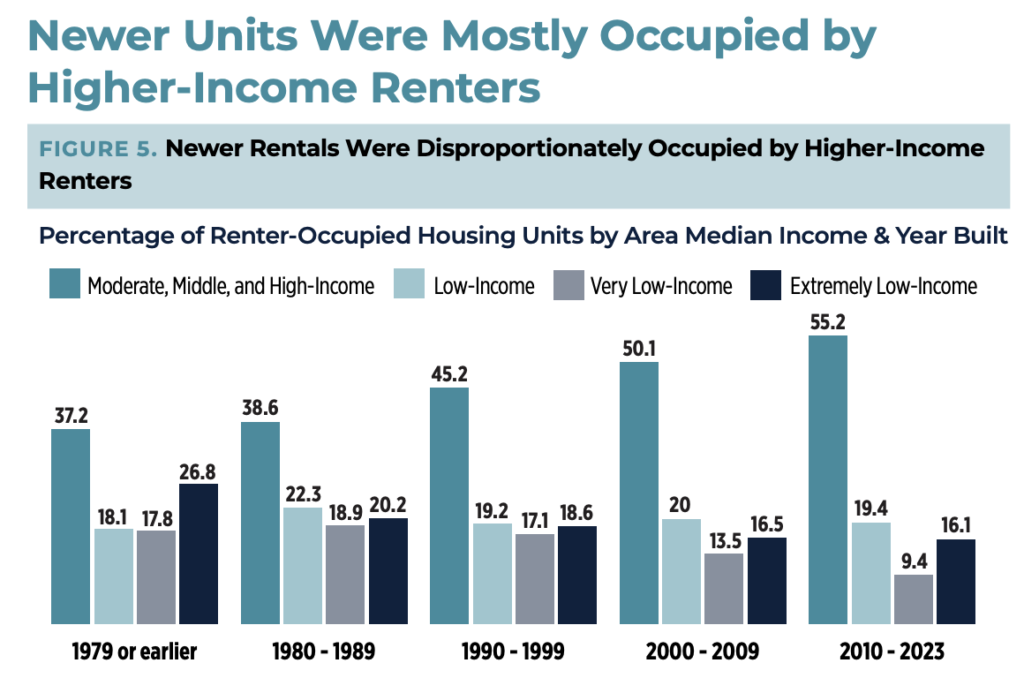
This letter dovetails nicely with a report released by Georgetown University in January titled “Abundance for Who?” Authors Zachary McRae, Shamal Sheppard, and Adit Roy reviewed nearly a decade of data from a half-dozen metro areas notable for their high levels of new construction. They found that “rent growth was generally higher for units serving households with the lowest incomes compared to those serving higher-income households.”
Furthermore, they write, “From 2015 to 2023, rents increased the most for units occupied by low-, very low-, or extremely low-income households.”
Just as we see in the Irvine/FRB letter, the Georgetown report found that new market-rate construction has skewed towards smaller households and higher-income tenants. As the authors note, “Among rental units built between 2010 and 2023, 44.4 percent were studios or one-bedrooms, approximately 15 percentage points higher than units built in the early 2000s…”
These units were also more expensive: “…the median rent for occupied units in these areas averaged $1,900 for those built in 2010 or later, compared to about $1,540 for older housing.”
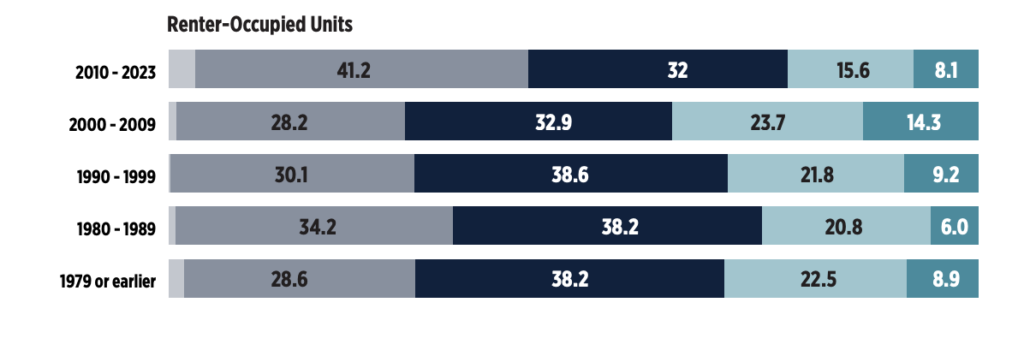
We shouldn’t be surprised, then, that the researchers found that newer units tended to be occupied by wealthier renters. Tenants with extremely low-, very low-, and low-incomes each accounted for less than one-fifth of occupants in newer units.
In her piece on the study for the New York Times, Ronda Kaysen put it succinctly, “The new rental housing that was built was often luxury housing, with studios and one-bedrooms, units that targeted young, single professionals but were too small and too expensive for low-income households with children.”
The research is clear: if we are going to address the housing crisis, we must address income inequality. If we want cities that work for everyone, we have to do more than just build.
It is only through policies and programs like those funded by ULA that we can create affordable and livable cities. If a city like Los Angeles is going to be something more than a playground for the rich, we have to do the hard work of protecting the tenants most vulnerable to displacement. We have to invest in the creation of affordable housing. And we need to create good union jobs that raise standards for the workers who serve our city.
ULA says “yes” to building the affordable housing LA needs most, AND it also says “yes” to investing in workers and tenants.
Let’s do that work together.

View video here
Ron’s ULA Success Story
Where the market fails, ULA succeeds.
Every day, ULA is helping people fight to stay in their homes. So far, ULA has supported more than 33,000 tenants with legal services and represented 11,000 tenants in court. Ron, one of those Los Angeles tenants, has shared his success story with us.
Ron was faced with a potential eviction. When he was told he had to leave his home, he didn’t know that he had the right to fight back. Ron connected with the Eviction Defense Network and Stay Housed LA and found the resources to help him work through the “extremely difficult process” of contesting an eviction.
We are in a battle for the future of America’s cities. In Los Angeles, we have the chance to fight on the side of humanity, to build a future where people can afford to live and work alongside their families and communities.
Building community means more than just building luxury apartments.
Let’s fight for a humane future.
Let’s fight for ULA.

Get the latest news on ULA and ULA-related actions on our Instagram: https://www.instagram.com/unitedtohousela/

ULA Resources
- LA Housing Department’s ULA Dashboards
- ULA Citizens Oversight Committee (COC)
- United to House LA Coalition
This newsletter is produced by the United to House LA (UHLA) Coalition that includes over 240 local nonprofit social service providers, community and tenant organizations, labor unions, affordable housing developers, faith-based organizations, and other groups that came together to craft Measure ULA and who have stayed together to make sure that its implementation is carried out effectively and efficiently by the City government.
If someone forwarded this email to you, and you want to sign up, click here.