
June 8, 2026
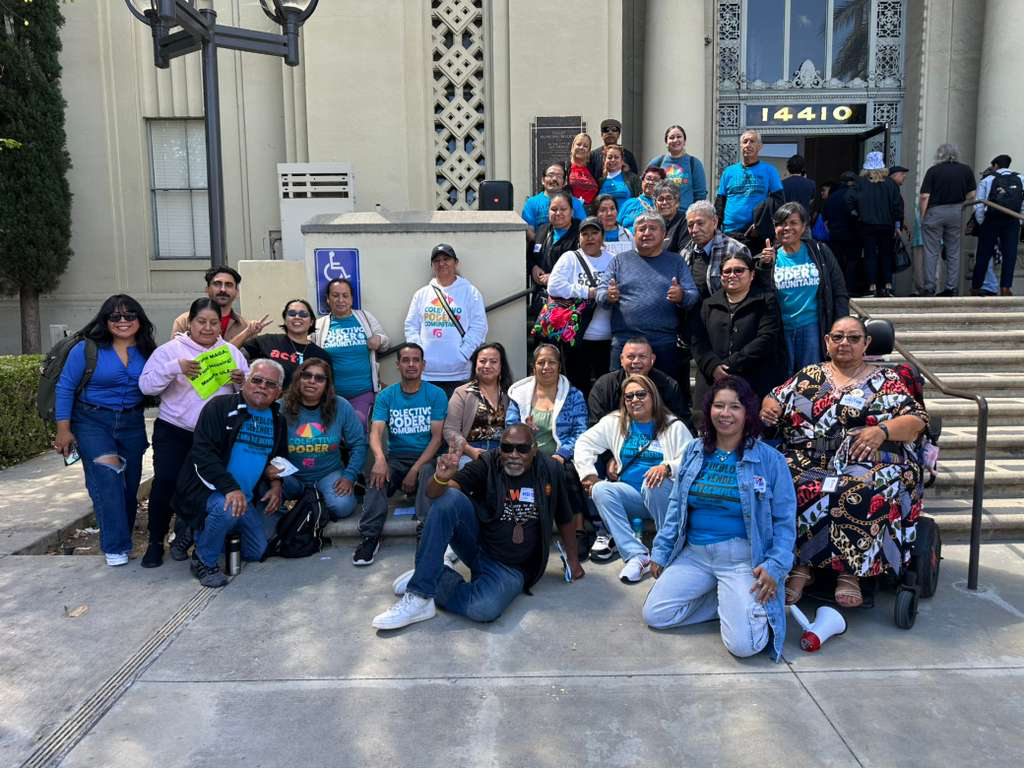
Ad Hoc Committee ends on a high note
On the last Friday in May, the City Council’s Ad Hoc Committee on Measure ULA concluded its work and advanced a compromise that is supported by United to House LA and will strengthen ULA’s effectiveness for years to come.
Even better? By passing it, Council can avoid a costly ballot campaign that would divert the resources we need to fight the “Taxpayer Deception Act” led by the Howard Jarvis Taxpayers Association and backed by the California Business Roundtable.
“I’m against going to the ballot, but I’m for making fixes that make [ULA] better,” Councilmember Ysabel Jurado said.
The compromise even includes a big demand that critics asked for—reductions in the ULA tax for new housing construction. Instead of a broad exemption that would have slashed ULA revenues, the Ad Hoc Committee recommended a narrow pilot program that would reduce the ULA tax for qualifying projects that include affordable housing and meet specific requirements to further the purposes of ULA, including paying prevailing wages during construction.
The exemption is based on sound research. While early reports about ULA’s effect on housing were severely overblown: the widely circulated RAND-UCLA paper that found a loss of 1,910 housing units annually was later shown to demonstrate no effect at all. But research by BAE suggested that there may be a sliver of multifamily developments, built to sell within seven years, that could be affected.
So it’s notable that the committee proposal included a ULA tax break for developments built for sale within seven years. This period of time is backed by research, unlike the broad 15-year exemption that was proposed by critics and some councilmembers, and which reports by city staff have shown would have a sharp or even devastating impact on ULA’s revenue.
Let’s look at those reports.
CAO: lower revenue, less affordable housing
One analysis, from the City Administrative Officer, looked at a number of potential ULA exemption scenarios and showed that the net change in affordable housing production results in a loss across the board with every type of exemption.
For instance, the retroactive 15-year exemption for new construction of all types (Scenario 1B), closest to what has been proposed by various councilmembers, showed 153 fewer affordable units by year one and 654 fewer units by year five. Overall, the CAO found that carveouts to ULA would result in less affordable housing production.
This deficit in affordable housing units would be accompanied by significant losses in revenue earmarked for ULA programs. No matter which proposed set of exemptions is used, the result is a loss of tens of millions of dollars of revenue that would be used to keep people in their homes.
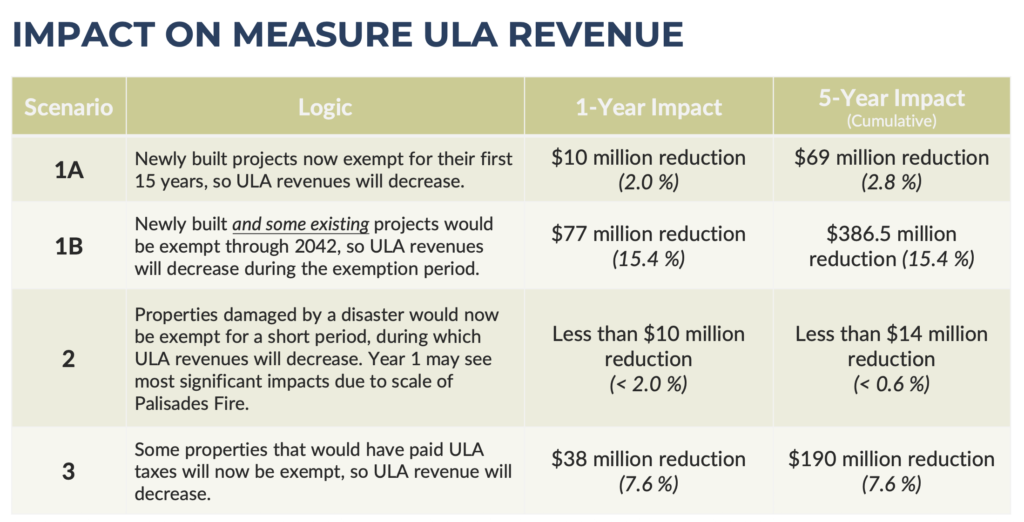
Proponents of these exemptions point to property tax revenues as a replacement for lost ULA funds. However, CAO demonstrates that the modest increase in property tax revenues that would accompany exemptions is far outweighed by ULA revenue losses. For instance, consider that one proposal would not only result in 654 fewer affordable housing units built, but also would reduce city revenues by $327.9 million over 5 years.
LAHD: death by 1,000 “targeted” cuts
The Los Angeles Housing Department (LAHD) has also released a report on proposed cuts to ULA that also demonstrates that exemptions and waivers would have a devastating impact.
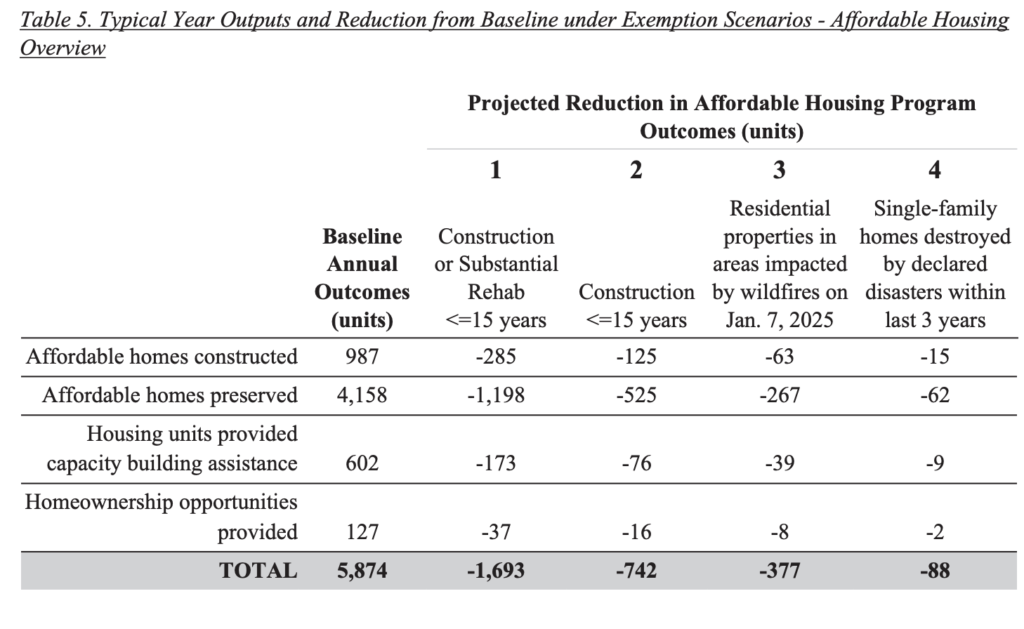
Though these proposed cuts have been presented as minor—referred to by advocates as “mending” ULA with “targeted” cuts—the reality is that these carveouts could reduce ULA revenue by up to 35%. Cutting ULA funding at this level could lead to a loss of close to two hundred million dollars every year.
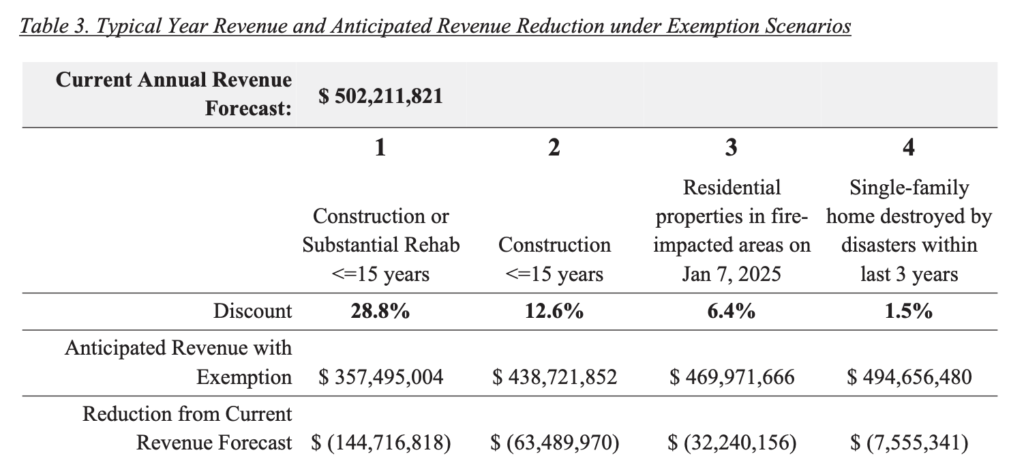
LAHD provided data on a number of proposed exemption and waiver scenarios and, in each case, the result would be devastating for Los Angeles renters.
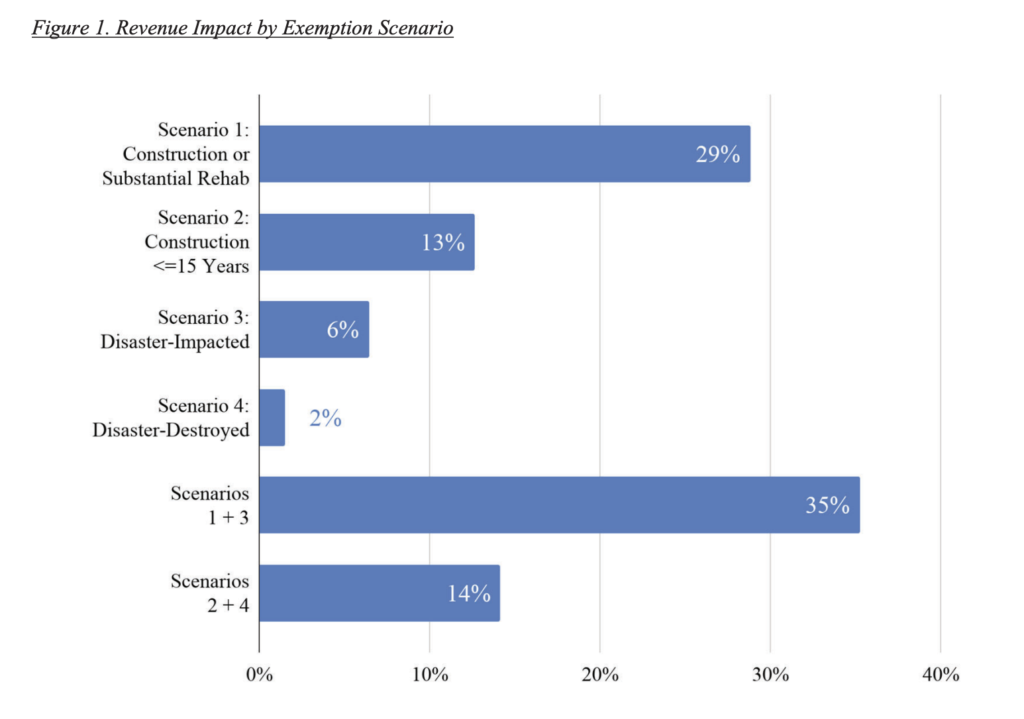
As you can see from this chart, the most destructive proposed cut stems from a January City Council motion that would exempt multifamily, commercial, and industrial buildings that were built or substantially rehabilitated within the last 15 years from ULA taxes. This proposal alone would reduce ULA funding by 29%.
Some opponents of ULA have proposed even steeper cuts that, even after the ULA period, would slash ULA rates for all multifamily, commercial, and industrial sales. That reduction in funds would be truly catastrophic.
Advocates for these cuts claim that they are interested in finding a more effective solution to the housing crisis; they neglect to mention that ULA creates affordable housing, and cuts to ULA would mean fewer affordable housing units in Los Angeles. As in the CAO Report, LAHD found that cuts to ULA would mean less affordable housing construction.
Opponents of ULA like to portray themselves as “practical,” but, as we can see from these reports, cutting ULA funds is anything but.
As Ted Chandler, senior adviser to the AFL-CIO Housing Investment Trust, said to the Ad Hoc Committee last month, “To think that the way we can solve an affordable housing construction crisis is to cut the funding for affordable housing construction makes no sense whatsoever.”
If we want to end the housing crisis, if we want to build more affordable housing, if we want to help renters across LA, the answer is ULA.
We applaud the Ad Hoc Committee’s proposed compromise and we hope that now we can get back to focusing on how to make ULA work the best that it can rather than trying to destroy LA’s most vital tool for keeping people housed.
More Amendments
There are a few more items in the proposal that came out of committee moved by Councilmember Jurado and supported by Councilmember Padilla:
- a program setting aside funds for “assistance for individuals transitioning out of homelessness into permanent housing solutions”
- a technical change to “provide greater clarity on the actions taken by the Citizen Oversight Committee”
- an instruction to LAHD “to report annually on the metrics described in the ULA Program Guidelines”
- requests for reports on bonding against ULA revenues (one of critics’ priorities), necessary staffing levels, and continued long-term study of ULA’s economic impacts, so measured decisions can be made about the future of the program as housing needs adjust over time.
Get the latest news on ULA and ULA-related actions
on Instagram: https://www.instagram.com/unitedtohousela/
on LinkedIn: https://www.linkedin.com/company/united-to-house-la

ULA Resources
- LA Housing Department’s ULA Dashboards
- ULA Citizens Oversight Committee (COC)
- United to House LA Coalition
This newsletter is produced by the United to House LA (UHLA) Coalition that includes over 240 local nonprofit social service providers, community and tenant organizations, labor unions, affordable housing developers, faith-based organizations, and other groups that came together to craft Measure ULA and who have stayed together to make sure that its implementation is carried out effectively and efficiently by the City government.
If someone forwarded this email to you, and you want to sign up, click here.