
July 6, 2026
Media coverage of Measure ULA shapes public sentiment. Now there’s evidence that major outlets have reported on Measure ULA as a business story first and an anti-homelessness effort a distant second.
But first, some breaking news:
Last Wednesday, the Los Angeles City Council voted to adopt the recommendations of the Ad Hoc Committee to make program changes to Measure ULA that don’t need to go to the ballot. This means certain projects built for sale within ten years can apply for exemptions from part or all of the ULA tax as long as they include prevailing wage labor and some affordable housing. It also means that Measure ULA is safe from substantial cuts for now. Last this week, we’ll send out a more comprehensive write-up that includes the recent political roller coaster in Sacramento as well.

Do you ever get the feeling that news coverage on Measure ULA leaves out a big part of the story? If so, you’re not alone.
Chris R. Martin, a professor of digital journalism at the University of Northern Iowa has conducted an analysis of media coverage of ULA and found that news outlets disproportionately used real estate industry-friendly framing in their reporting, often ignoring the benefits of ULA while highlighting criticisms from longstanding opponents of the measure.
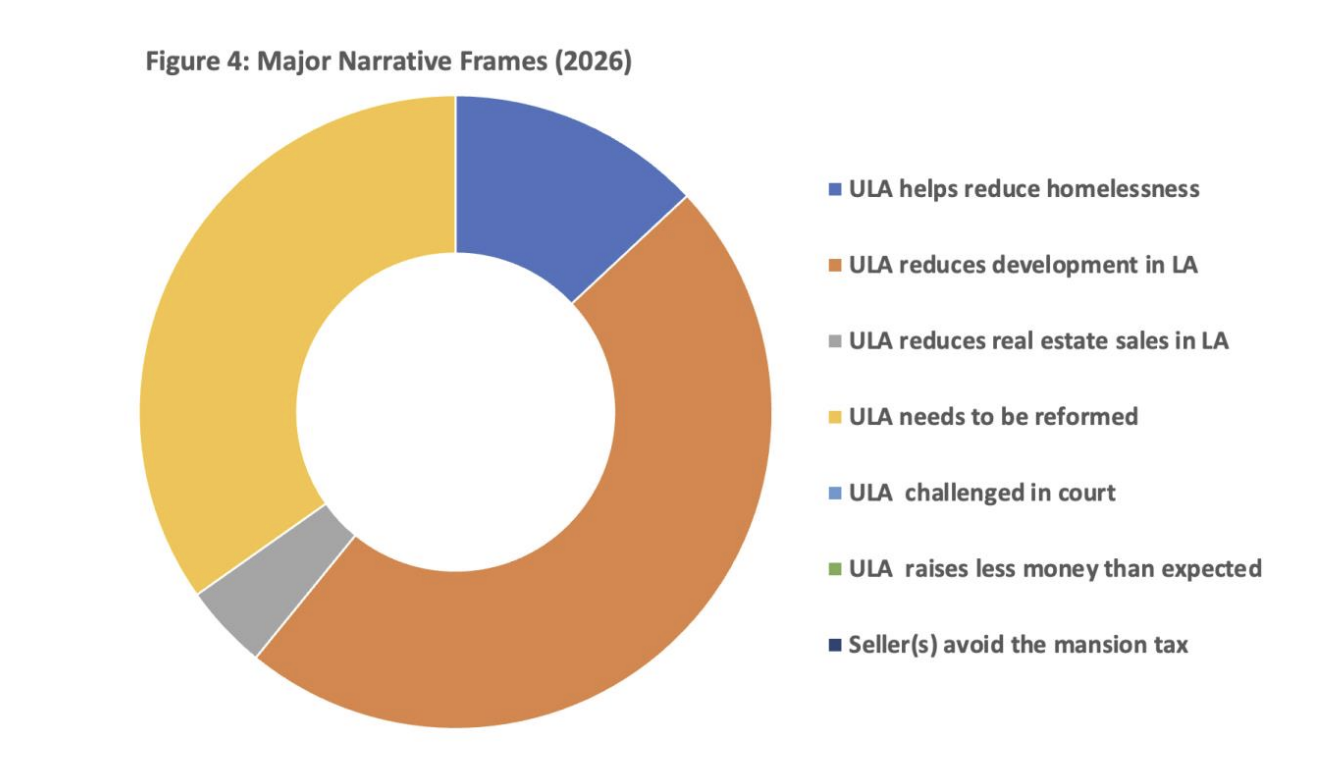
In the report, Martin writes, “At the end of three years of local news coverage about ULA from the Los Angeles Times and LAist, the news audience was left in early 2026 with two dominant news frames – that ULA reduced housing development in Los Angeles and ULA needs to be reformed.”
Not only are these claims based on flawed studies that have been debunked, but this framing ignores the successes ULA has had as a homelessness prevention initiative. It elevates real estate industry grievances over the measure’s actual purpose. In fact, Martin points to a number of cases where the framing of outspoken opponents of ULA, such as the Howard Jarvis Taxpayers Association (whose measure unwinding ULA won’t be on the November ballot), shaped the narrative around ULA.
Martin’s research shows how these two outlets built a foundation for the way people understand ULA locally and nationally. He saw that the national news media, local and state politicians, and a statewide ballot initiative repeated the same two faulty dominant news frames, with no additional analysis or questions.
It’s striking that Martin found that in the 97 stories he reviewed from the Los Angeles Times and LAist published between 2023 and 2026, only 7% of stories bothered to include the perspective of people who were homeless or who were helped to stay in their home by a tenant program. Almost all of those stories were published in the early years of his sample, in 2023 or 2024. 30% of the pieces Martin examined didn’t even use the words “homeless” or “homelessness” in the story.
The result of this framing is that ULA has been presented in the media as an obstacle for the real estate industry rather than a much needed tool for fighting LA’s housing crisis. One of LA’s greatest accomplishments in the era of ULA, a 17.5% decline in street homelessness, is not mentioned once in the coverage he followed.
For three years, real estate interests ”flooded the zone” with complaints, criticisms, and flawed data around ULA, and LA media rewarded them with favorable coverage. These figures from Martin’s study show that negative framing of ULA increased substantially as the real estate industry launched its attacks:

Martin identifies a sharp pivot in news coverage of ULA beginning in 2024. He writes:
“A Los Angeles Times story from April 1, 2024 captured the beginning of a pivot to news stories of corporate criticisms of ULA in the news media. The story began with this lead sentence: ‘One year ago, Los Angeles’ ‘mansion tax’ took effect. It has either been a godsend or an absolute disaster, depending on who you ask.’”
From this point on, the Times and LAist increasingly chose only to consult those who see ULA as a disaster (real estate interests) while ignoring those who might view it as a godsend (low-income renters facing eviction). Notice how the dark blue (representing the positive frame of reducing homelessness) shrinks over time, while the orange and yellow (negative frames) expand. Yet, during this same time period, ULA was stacking its impact in terms of reduction in homelessness, increases in affordable housing and deepening renter protections.

By early 2026, two negative talking points (“reduces development”/”needs to be reformed”), both wholly constructed by the real estate lobby, dominated ULA coverage.

Do these narratives have an impact on public opinion and perspectives held by policymakers? Absolutely, which is why daylighting these biases can help protect ULA from recurrent attacks.
Is there any hope to change this story? We think there is.
Now that studies have debunked flawed narratives and hundreds of millions of dollars in ULA funding continues to flow into programs that combat homelessness, we would expect to see a shift as the compounding impacts of ULA’s housing solutions become too much to ignore. Yet, we know real estate interests will continue to try push their anti-ULA narratives.
The program changes made this week in City Council may or may not soothe critics, but they should allow the rest of Los Angeles to see that Measure ULA was made to be improved as we learn more about how it works. The $544 million spending plan announced last week should help accelerate that shift as well. In three years of existence, ULA has raised over a billion dollars in revenue to fight the housing crisis, has funded over 5,600 units of affordable housing, and helped over 11,000 people stay in their homes, with much more to come.
Let’s celebrate the achievements of ULA and keep telling our story as it delivers results.
Get the latest news on ULA and ULA-related actions
on Instagram: https://www.instagram.com/unitedtohousela/
on LinkedIn: https://www.linkedin.com/company/united-to-house-la

ULA Resources
- LA Housing Department’s ULA Dashboards
- ULA Citizens Oversight Committee (COC)
- United to House LA Coalition
This newsletter is produced by the United to House LA (UHLA) Coalition that includes over 240 local nonprofit social service providers, community and tenant organizations, labor unions, affordable housing developers, faith-based organizations, and other groups that came together to craft Measure ULA and who have stayed together to make sure that its implementation is carried out effectively and efficiently by the City government.
If someone forwarded this email to you, and you want to sign up, click here.